Are tight calves sabotaging your workouts and putting your ankles at risk? Discover why standard calf stretches often fail and how a simple “3-angle” secret can unlock your mobility, improve your squat depth, and protect you from painful sprains. If you’ve been feeling “stiff” or “locked up,” it’s time to stop stretching like it’s 1985 and start using functional science to bulletproof your lower body. Read on to transform your movement in just minutes a day.
Calf Stretch: The “3-Angle” Secret to Unlocking Your Ankles and Improving Performance
If you’ve ever felt like your ankles are made of wood, or if you struggle to get deep in a squat without your heels lifting off the floor, you don’t just have a “mobility issue.” You likely have a calf problem.
Most people treat the calf as a single, stubborn muscle that needs to be pulled on occasionally. In reality, your calves are the “gatekeepers” of your lower body movement. When they are tight, they act like a parking brake on your ankles, forcing your knees, hips, and lower back to pick up the slack. This doesn’t just slow you down; it’s a direct ticket to ankle sprains and chronic pain.

In this guide, we’re moving past the basic “lean against a wall” routine. We’re looking at the modern sports science of the calf stretch, the anatomy of the gastrocnemius and soleus, and why “active loading” is the only way to make your flexibility gains stick.
The “Squat Test”: Are Your Calves Holding You Back?
Want to see how much your calves are inhibiting you right now? Try this simple test:
- Stand with your feet shoulder-width apart and try to perform a deep squat. Notice how far down you go before your heels want to lift or your chest starts to collapse forward.
- Now, grab a thick book or a small wood block and place it under your heels (keep the balls of your feet on the ground).
- Perform the squat again.
The Result? For most people, the second squat feels “magical.” It’s deeper, more stable, and more upright. The Lesson: Your hips and knees were probably fine; your tight calves were simply refusing to let your ankles bend (dorsiflex) far enough to let you descend. If you live your life in this “tight” state, you are constantly straining your joints. This is a primary stiff ankle cause that leads to long-term wear and tear.—
Modern Science: Why Static Stretching Isn’t Enough
For years, we were told to hold a stretch for 30 seconds and call it a day. While static stretching has its place, recent 2025 research suggests we need a more dynamic approach to truly “remodel” the tissue.
Expert Insight #1: The Power of Dynamic Loading
A March 2025 study published in the International Journal of Health Sciences and Research (IJHSR) compared static vs. dynamic stretching. The researchers found that while both improve range of motion, dynamic stretching significantly improved “musculotendinous stiffness” and agility—essentially making the muscle more functional for real-world movement, not just flexible on paper.
The Death of R.I.C.E.
If you are stretching because your calves or ankles feel “inflamed” after an injury, do NOT reach for the ice. Modern sports medicine has retired the R.I.C.E. (Rest, Ice, Compression, Elevation) method. Research in Nature and Science Direct shows that ice actually stalls the healing process by constricting blood vessels and stopping the “cleanup crew” of cells from repairing the tissue. Instead, we use active restoration to flush out inflammation naturally.
The “3-Angle” Calf Stretch Protocol
The secret to a truly effective calf stretch is understanding that the calf isn’t one flat muscle. It’s a complex of three dimensions. If you only stretch the center, you’re leaving 66% of the muscle “locked.”
 1. The Wall Calf Stretch (Back Foot)
This is your bread and butter, but with a twist.
- How to do it: Place your hands on a wall, step one foot back, and keep that back heel glued to the floor. Lean forward until you feel a stretch in the center of the calf.
- The 3-Angle Secret: While keeping your lower body still, lean your upper body slightly to the right. You’ll feel the stretch move to the outside of the calf. Hold for 10 seconds. Now, lean slightly to the left. You’ll feel it on the inside.
 2. The Advanced Wall Stretch (Front Foot)
This increases the leverage on the ankle joint, making it a “power” stretch for dorsiflexion.
- How to do it: Stand close to the wall. Prop the ball of your foot up against the wall while keeping your heel on the floor. Stand up straight.
- The 3-Angle Secret: Again, rotate your hips and upper body side-to-side to hit the medial and lateral fibers of the calf. This is essential for people with weak ankles who need to build resilience in every plane of motion.
3. The Bent-Knee Stretch (Soleus & Achilles Focus)
The previous two stretches hit the Gastrocnemius (the big “double” muscle). But if you don’t bend your knee, you miss the Soleus—the deeper muscle that is actually more responsible for ankle stability.
- How to do it: Get into the same position as Stretch #2, but bend the knee of the leg you are stretching. You will feel the stretch move down toward your Achilles tendon and heel.
- Why it matters: This is where most ankle injuries are born. A tight Soleus is the leading cause of “stiff” feeling in the morning.
Main Benefits of Active Calf Rehabilitation
- Increased Ankle Range: By “unlocking” the calves, your ankle can move freely, reducing the risk of a “roll” or sprain.
- Improved Athletic Power: A flexible calf can store and release more elastic energy (think of it like a spring), making you faster and more explosive.
- Knee & Hip Protection: When your ankles bend properly, your knees don’t have to over-compensate, reducing the risk of ACL and meniscus issues.
- Better Gait Mechanics: No more “walking like a penguin.” You’ll achieve a natural heel-to-toe strike that saves your lower back.
Warning: What Happens If You Neglect Your Calves?
Neglecting calf flexibility isn’t just about being “stiff.” It has a cascading effect on your health:
- Muscle Atrophy and “Shortening”: If you spend all day in shoes or sitting, your calves actually physically shorten. This makes the tissue brittle and prone to tearing (Achilles rupture).
- The Ankle Brace Trap: Many people use braces to “protect” their ankles. But braces cause the calf muscles to stop working. Over time, this leads to permanent instability because the “natural brace” of your muscles has withered away.
- Permanent Stiffness: Without regular mobilization, the body lays down disorganized scar tissue in the fascia, making the stiffness much harder to reverse as you age.
The Solution: HEM Ankle Rehab
Stretching is only half the battle. To truly bulletproof your lower body, you need a system that combines flexibility, strength, and stability.
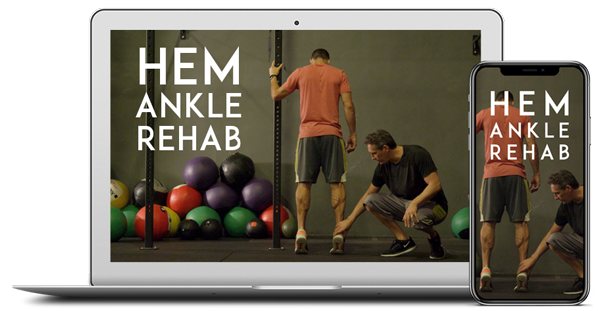
This is where HEM Ankle Rehab comes in. While a single “calf stretch” helps the symptoms, HEM addresses the root causes of ankle and calf dysfunction. It is the premier at-home treatment for anyone who wants to:
- Recover from an ankle sprain in days, not weeks.
- Build a “natural brace” through functional muscle activation.
- Ditch the outdated R.I.C.E. method and use modern, active recovery.
By moving through a structured progression of movement, you ensure that your calf flexibility actually translates into stability. If you’re tired of your ankles feeling like a liability, it’s time to try the HEM Ankle Rehab program.
People Also Ask (FAQ)
How long should I hold a calf stretch?
Modern guidelines suggest 30 seconds per angle for a total of 90 seconds per calf. However, frequency is more important than duration. Three short sessions a day are better than one long one.
Can tight calves cause plantar fasciitis?
Absolutely. The calf and the plantar fascia are connected via the Achilles tendon. If the calf is tight, it pulls on the heel, which in turn yanks on the bottom of your foot. Stretching your calves is often the “missing link” in fixing heel pain.
Is it better to stretch calves before or after a workout?
Dynamic stretching (movement-based) is best before a workout to prime the muscles. Static stretching (holding the pose) is best after a workout when the muscles are warm and more pliable. For more on timing, read our guide on the best treatment for ankle injuries.
Final Thoughts
Don’t let tight calves dictate how you move. By using the “3-Angle” wall stretch and incorporating active, functional loading, you can protect your ankles and reclaim your performance. Remember: Rest is the enemy of recovery. Get moving, stay active, and let your body’s natural mechanics do the work.
Ready to fix your ankles for good? Get started with HEM ANKLE REHAB today!