If you have ever felt a sharp, pinching sensation in the front of your ankle during a deep squat, or if you feel like your “stiff ankles” are the reason you can’t run as fast as you used to, you are dealing with an ankle dorsiflexion deficit.
In the world of sports medicine and high-performance training in 2026, we’ve moved past the idea that ankle stiffness is just something you “live with.” We now know that ankle dorsiflexion—the ability to pull your toes toward your shin—is the foundation for almost every athletic movement. If this hinge is rusty, your knees, hips, and lower back will eventually pay the price.
Whether you are recovering from a grade 2 ankle sprain or you’ve just noticed your mobility isn’t what it used to be, this guide will show you how to “unstick” your joints using modern, functional science. We’re moving beyond the “ice and rest” era and into a world of active, high-authority rehab.

What is Ankle Dorsiflexion, Really?
Simply put, ankle dorsiflexion is the movement that happens when the angle between your foot and your shin decreases. It’s the “upward” bend. While it sounds simple, the mechanics are complex. This movement occurs primarily at the talocrural joint, where your shin bones (tibia and fibula) sit on top of your foot bone (the talus).
In a healthy ankle, as your knee travels forward (like in a lunge or a squat), the talus bone must glide backward into the joint space. If that bone gets “stuck” forward—often due to old injuries—you hit a hard mechanical stop. No amount of calf stretching will fix a bone that is physically in the way.
The Warning: The Hidden Cost of Neglecting Your Ankles
When you ignore poor dorsiflexion, you aren’t just dealing with a minor range-of-motion issue. You are inviting a “domino effect” of compensation throughout your entire body. Here is what happens when your ankles stay stiff:
- Knee Pain (Patellar Tendonitis): If your ankle won’t bend, your knee has to take on more shear force to get you through your gait or lift.
- The “Butt Wink”: In the gym, limited dorsiflexion forces your lower back to round at the bottom of a squat to find depth, which is a fast track to a herniated disc.
- Plantar Fasciitis: A stiff ankle joint puts massive strain on the arch of the foot, leading to that “stabbing” heel pain first thing in the morning.
- Chronic Instability: When the joint doesn’t move right, the brain stops trusting it, leading to a cycle of rolling your ankle over and over again.
Why “R.I.C.E.” and Braces are Killing Your Progress
If you’ve been told to Rest, Ice, Compress, and Elevate (R.I.C.E.), you are following advice that is nearly 50 years out of date. In 2026, the leading sports scientists have abandoned this method for several critical reasons:
1. The Stagnation Trap
Resting an ankle for too long is the worst thing you can do for dorsiflexion. Within just 48 hours of total rest, your muscles begin to atrophy and your joint capsule starts to thicken with disorganized collagen. This creates permanent stiffness and “scar tissue” that acts like internal glue, making it even harder to regain your range of motion later.
2. The “Ice” Paradox
We’ve been conditioned to think inflammation is the enemy. It’s actually the cleanup crew. By icing, you constrict blood vessels and prevent the delivery of healing cells. As discussed in our deep dive into why ice might not be the best strategy, numbing the pain doesn’t mean you are healing the tissue. It often just delays the inevitable rehab process.
3. The Weakness of Braces
Wearing an ankle brace is like putting your leg in a cast. While it might make you feel “safe,” it actually causes your stabilizing muscles to “shut off.” This leads to muscle weakness and permanent instability. You want an ankle that is an active stabilizer, not a passive one that relies on plastic and Velcro to stay upright.
Modern Science: 3 Breakthroughs in Ankle Mobility (2026)
To fix a pillar movement like dorsiflexion, we have to look at what the latest clinical research tells us. These three insights are the backbone of modern rehab:
Expert Insight 1: Mechanotransduction
According to a 2026 landmark review in MDPI, “Mechanotherapy” is the future. It proves that the only way to truly repair damaged ligaments and restore joint range is through controlled mechanical loading. Stretching isn’t enough; you must put the tissue under tension to trigger cellular repair. Explore the 2026 study on Mechanotherapy.
Expert Insight 2: The Talar Glide Breakthrough
Research published in PubMed (PMC5361008) highlights that many mobility “blocks” are actually posterior talar glide deficits. If the talus bone doesn’t slide back, the ankle can’t hinge. This study found that manual “gliding” techniques significantly improved gait and balance compared to standard stretching. Read the Talar Glide study here.
Expert Insight 3: Sensory-Motor Re-Wiring
A recent study in the Journal of Athletic Training shows that chronic ankle issues are often a “brain” problem. When you lose dorsiflexion, your brain loses the map of where your foot is in space (proprioception). Functional rehab must “re-wire” this connection to prevent re-injury. View the JAT Proprioception research.
Main Benefits of Optimal Ankle Dorsiflexion
When you restore your ankle’s natural hinge, the “lightbulb” goes on for your movement. You can expect:
- Instant Squat Depth: No more “heels lifting” or leaning too far forward.
- Enhanced Running Economy: A more powerful “toe-off” and better shock absorption on landing.
- Injury Prevention: Massive reduction in the risk of ACL tears, shin splints, and Achilles tendonitis.
- Better Agility: The ability to change direction quickly without the ankle “giving way.”
How-To: Restoring Your Range of Motion
The Test: The 5-Inch Wall Challenge
Stand facing a wall. Put your big toe 5 inches (about a fist-width plus a thumb) away from the wall. Without lifting your heel, try to touch your knee to the wall. If you can’t, or if your foot “collapses” inward to get there, you have a mobility deficit.
The Fix: 3 Steps to Better Mobility
- Soft Tissue Release: Use a lacrosse ball or foam roller on the Soleus (the lower calf). Unlike the upper calf, the soleus is a major “anchor” for ankle stiffness.
- Banded Joint Distraction: Anchor a heavy resistance band behind you. Place the other end around the very top of your foot (below the shin bones). Lunge forward. The band will pull the talus bone backward, creating the “glide” needed for movement.
- Tibialis Strengthening: You must strengthen the muscles on the front of the shin to “pull” the foot into dorsiflexion. Try 3 sets of 20 Tibialis Raises (leaning against a wall and lifting your toes).
The Ultimate Solution: HEM Ankle Rehab
While daily stretches are a good start, they rarely fix the root cause of chronic stiffness. If you want to stop guessing and start healing, you need a system that addresses the joint, the muscles, and the nervous system all at once.
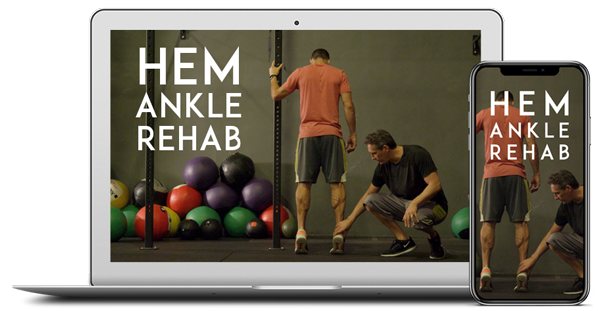
HEM Ankle Rehab is the premier at-home system designed to restore full, pain-free dorsiflexion. Unlike traditional physical therapy that focuses on “strengthening” a stuck joint, HEM focuses on functional restoration.
Whether you are dealing with chronic ankle pain or a recent injury, HEM uses a proprietary three-step approach to flush out waste, re-align the joint, and bulletproof the ligaments. It’s the same methodology used by elite athletes to bypass the “rest and ice” trap and get back on the field in record time.
Common Questions (People Also Ask)
How long does it take to improve ankle dorsiflexion?
If the issue is purely muscular (tight calves), you can see changes in 2–4 weeks. If the issue is “capsular” (a stuck joint), it may take 6–8 weeks of consistent mobilization using a system like HEM Ankle Rehab to remodel the tissue.
Can I run with poor dorsiflexion?
You can, but you are likely “over-striding” or landing with a flat foot to compensate. This significantly increases the risk of stress fractures and knee pain. It is better to address the mobility first to ensure a safe running gait.
Why does my ankle pinch in the front?
This is often “Anterior Impingement.” It happens when the soft tissue or the bones themselves get compressed because the talus isn’t gliding backward properly. Stop “forcing” the stretch and start using joint distraction techniques.
The Bottom Line
Your ankles are the foundation of your entire movement “house.” If the foundation is tilted, the whole building is at risk. By moving away from the R.I.C.E. method and embracing active, science-backed rehab, you can reclaim the mobility you thought was gone forever.
Stop settling for stiff, “weak” ankles. Take control of your recovery today and experience what it feels like to move without limits.
Ready to start? Get the HEM Ankle Rehab system here and fix your ankles for good.