You’re standing in line at the grocery store, and there it is again—that dull, aching throb in the middle of your foot that radiates up into your ankle. By the time you get to the car, your lower back is tight, and your knees feel like they’ve aged ten years in a single afternoon. If you’ve been told you have fallen arches, you know this isn’t just a “foot problem”; it’s a foundation problem that affects how you move, breathe, and live.

For decades, the world has told you that the only solution is to shove a piece of rigid plastic into your shoe and hope for the best. But in 2026, we know that “propping up” a collapsed arch with a permanent crutch often makes the problem worse. It’s time to stop masking the symptoms and start fixing the root cause. In this guide, we’ll explore why your arches collapsed, the hidden dangers of the old-school advice, and how modern sports medicine can help you rebuild a bulletproof foundation through active recovery.
The Problem: Why Your “Foundation” is Crumbling
To understand fallen arches (clinically known as pes planus), think of your foot as a complex architectural bridge. This bridge is held together by bones, ligaments, and a crucial “cable” called the posterior tibial tendon. When this system is working, the arch acts as a high-performance shock absorber, distributing the force of every step you take.
When arches “fall,” it’s usually not a sudden event like a bone break; it’s a gradual loss of structural integrity. The “cables” get tired, the ligaments stretch out, and the bridge begins to touch the ground. This isn’t just about flat feet—it’s about a loss of functional capacity. When your foot flattens, your entire leg rotates inward, putting an unnatural twist on your knee, your hip, and your spine. This is why “mystery” back pain often starts at the sole of the foot.
Fallen Arches vs. Naturally Flat Feet
There is a massive difference between being born with flat feet and developing fallen arches later in life. If you’ve always had flat feet and you move without pain, your body has likely adapted. However, if you had an arch and it is now disappearing, you are likely dealing with Posterior Tibial Tendon Dysfunction (PTTD). This is an active breakdown of the support system that requires immediate, functional attention before it leads to weak ankles and chronic inflammation.
The Warning: What Happens if You Neglect the Collapse?
Ignoring fallen arches is like ignoring a cracked foundation in your home. It might hold up for a few months, but eventually, the windows won’t open and the roof will leak. If you neglect the signal your feet are sending you, you are risking a cascade of long-term damage:
- Secondary Injuries: Plantar fasciitis, shin splints, and Achilles tendonitis are almost guaranteed companions of untreated fallen arches.
- Joint Degeneration: Because your alignment is off, the cartilage in your knees and hips wears down unevenly, leading to early-onset osteoarthritis.
- The “Neurological Blackout”: Your feet are loaded with sensory nerves. When the arch collapses and stays stiff, your brain loses its “GPS connection” to the ground, significantly increasing your risk of a rolling ankle injury.
⚠️ Why R.I.C.E. and Braces Are Outdated
If you’ve been told to follow R.I.C.E. (Rest, Ice, Compression, Elevation) or to wear a rigid ankle brace 24/7, you are getting advice that is nearly 50 years old. In 2026, we know that total rest is toxic to foot health.
When you “rest” a fallen arch, the muscles that are supposed to be supporting you begin to wither away (atrophy). When you “ice” the pain, you constrict the blood flow needed to repair the tendons. And when you wear a rigid brace or a permanent arch support, you are effectively putting your foot in a cast. This leads to permanent instability because your brain forgets how to use the muscles in your foot, making you dependent on the “crutch” forever.
Modern Science: The 2026 Standard for Foot Health
The world of sports medicine has shifted from “supporting” the foot to “rebuilding” the foot. We now focus on the “Foot Core System”—the idea that your foot has its own internal musculature that must be trained just like your abs or your glutes.
Expert Insight 1: The End of lifelong Orthotic Dependency
A 2025 study published in the Journal of Foot and Ankle Research demonstrated that while orthotics can provide short-term pain relief, they do not “fix” fallen arches. The research found that patients who relied solely on orthotics had 30% weaker intrinsic foot muscles after 12 months compared to those who used active loading protocols. Source: J Foot Ankle Res.
Expert Insight 2: Mechanotransduction in Tendon Repair
According to research highlighted by the British Journal of Sports Medicine (BJSM), tendons—like the posterior tibial tendon—require “optimal loading” to heal. Total rest causes tendons to become “mushy” and disorganized. Active functional movement signals the body to align collagen fibers, making the arch resilient again. Source: BJSM Mechanotherapy Guide.
Expert Insight 3: Proprioceptive Retraining
The Journal of Athletic Training has recently emphasized that “unstable surface training” and barefoot mechanics are superior for restoring the neural pathways between the foot and brain, which are often damaged when the arch falls. Source: JAT Neuromuscular Meta-Analysis.
The Solution: Active Functional Rehab
If you want to walk, run, and jump without pain, you need a solution that goes beyond a temporary Band-Aid. You need Active Functional Rehab. Instead of asking your shoes to do the work, you need to train your body to do the work.
The goal is to increase blood flow (vascularization), restore flexibility to the ankle joint, and “re-wire” the nerves in your feet so they can support your weight naturally. This is the only way to achieve long-term stability and freedom from pain.
Main Benefits of Active Rehab:
- Natural Shock Absorption: Rebuilding the arch restores your body’s ability to absorb impact, protecting your knees and back.
- Increased Athletic Power: A strong arch provides a rigid lever for “toe-off,” making you faster and more explosive.
- True Stability: You won’t have to fear uneven ground or “giving out” because your muscles will be strong enough to react in milliseconds.
- Independence: Imagine being able to walk around the house—or even the beach—barefoot without agony.
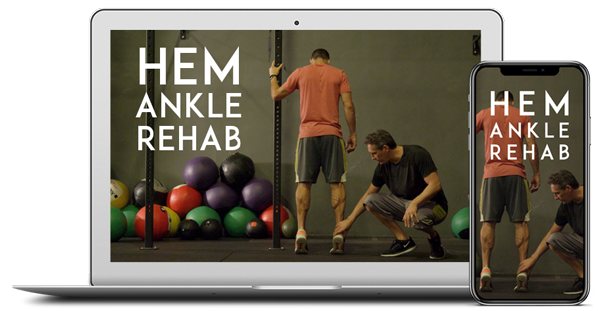
The premier at-home treatment for restoring this kind of functional integrity is HEM Ankle Rehab. While many think it is only for sprains, the HEM system is designed to address the entire ecosystem of the lower leg and foot. By focusing on circulation, flexibility, and stability, it helps “wake up” the structures that have been dormant since your arches fell. It moves you away from the “rest and ice” trap and into a world where your foot is a fortress, not a liability.
How-to: 3 Steps to Reclaim Your Arches
1. Wake Up the “Short Foot”
Most people with fallen arches have “lazy” intrinsic muscles. Practice the “Short Foot” exercise: Sit with your foot flat on the floor. Without curling your toes, try to pull the ball of your foot toward your heel, “shortening” the foot and creating a small lift in the arch. Hold for 5 seconds. This is the “plank” for your foot.
2. Rebuild Ankle Dorsiflexion
When arches fall, the ankle joint often becomes stiff. If your ankle can’t bend properly, the foot must flatten to get you forward. Use gentle, active range-of-motion drills to ensure your ankle can hinge correctly. This removes the pressure that forces the arch to collapse further with every step.
3. Eccentric Loading
You must strengthen the posterior tibial tendon. The most effective way is through slow, controlled “calf raises.” Rise up on two feet, then slowly lower yourself down over a count of 3 to 5 seconds. This slow lowering (eccentric phase) is what triggers tendon repair and structural remodeling.
People Also Ask (FAQ)
Can fallen arches be reversed?
While you may not always return to a high, “ballet-style” arch, you can absolutely reverse the symptoms and functional deficits. By strengthening the muscles and tendons, you can create a “functional arch” that supports your weight and eliminates pain, even if the structural appearance remains somewhat flat.
Is it bad to wear arch supports all the time?
Think of arch supports like a neck brace. They are great for short-term protection, but if you wear one forever, your neck muscles will get weak. In 2026, we recommend using orthotics as a temporary tool while you simultaneously perform an active rehab program like HEM Ankle Rehab to build your own internal strength.
Can fallen arches cause knee and hip pain?
Absolutely. When the arch collapses, the shin bone (tibia) rotates inward. This puts a “twisting” stress on the knee and pulls the hip out of alignment. If you have “mystery” knee pain, the solution often lies in fixing your feet.
How do I know if my arch is actually “fallen”?
The easiest test is the “Wet Footprint” test. Wet your foot and step on a piece of cardboard. If you see the entire shape of your foot with no curve where the arch should be, your arches are flat. If this is accompanied by pain on the inside of the ankle, they have likely “fallen.”
The Final Word on Your Foundation
Fallen arches are a signal from your body that your foundation is under stress. You have two choices: you can ignore the signal and wait for the rest of your joints to fail, or you can take an active role in your recovery.
The days of suffering in silence or relying on expensive, rigid shoe inserts are over. By embracing the 2026 standard of active, functional rehab, you can rebuild your strength, reclaim your mobility, and stop living in fear of the next long walk. Your feet are designed to be strong—it’s time to start treating them that way.
Ready to rebuild your foundation? Join the HEM Ankle Rehab program today and start walking without limits.