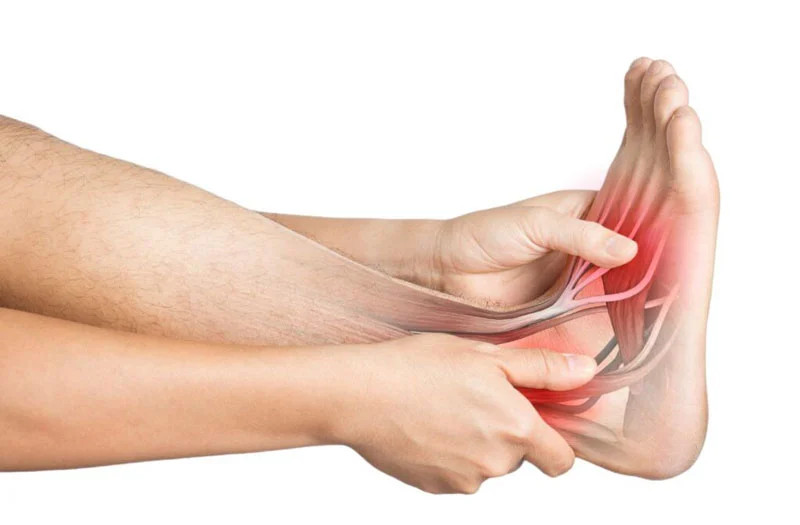
Have you ever felt a sharp, nagging pain radiating across the top of your foot and into your ankle. Maybe it feels like your laces were tied too tight yesterday, or perhaps it’s a deep, thumping ache that won’t quit. You check for swelling, try to wiggle your toes, and wonder: “Did I just overdo it, or is something actually broken?”
If you are dealing with top of your foot and ankle pain, the uncertainty is often as frustrating as the discomfort itself. Is it a simple case of extensor tendonitis, or are you looking at a more serious metatarsal stress fracture?
In this guide, we’re going to look at the latest sports medicine insights to help you tell the difference. More importantly, we’re going to explain why the old-school advice of “just rest and ice it” is actually holding your recovery back, and how active, functional rehab can get you back on your feet faster than you thought possible.
Tendonitis vs. Stress Fracture: How to Tell the Difference
While both conditions can cause significant top of foot and ankle pain, they behave very differently under pressure. Understanding these nuances is the first step toward the right treatment.
The Signs of Extensor Tendonitis
Extensor tendonitis is the irritation or degradation of the tendons that pull your toes upward. It usually presents as:
- Crepitus: A “crunchy” or “creaky” sensation when you move your toes.
- Surface Pain: The pain feels close to the skin, often directly over the tendons.
- The “Lace Test”: Pain often flares up when you wear shoes or when the top of the foot is compressed.
The Signs of a Stress Fracture
A stress fracture is a tiny crack in the bone—often the metatarsals—caused by repetitive stress. This is a structural issue, not just a soft tissue one. Watch for:
- Pinpoint Tenderness: If you can poke one specific spot on the bone and it sends you through the roof, it’s a red flag for a fracture.
- Night Pain: Unlike tendonitis, which often settles when you’re still, a stress fracture might throb even while you’re lying in bed.
- Visible Swelling: Significant “puffy” swelling on the top of the foot that doesn’t go away with a few hours of elevation.
Modern Science: Why the R.I.C.E. Method is Officially Outdated
For decades, everyone from coaches to doctors told you to “R.I.C.E.” (Rest, Ice, Compression, Elevation) for any foot or ankle injury. In 2026, we know better. Even the doctor who coined the term R.I.C.E. has since retracted it because ice and total rest actually delay healing.
Modern sports medicine has shifted toward protocols like PEACE & LOVE (Protect, Elevate, Avoid Anti-inflammatories, Compress, Educate & Load, Optimism, Vascularisation, Exercise). A study published in the British Journal of Sports Medicine (BJSM) highlights that soft tissues—and even bones—need controlled mechanical stress (Optimal Loading) to repair themselves correctly.
Furthermore, recent evidence from PubMed Central (PMC) suggests that the cooling effect of ice can actually disrupt the natural inflammatory cascade, which is essential for triggering the repair of damaged tendons and bones. By suppressing inflammation, you are essentially turning off the “rescue workers” that your body sent to fix the damage.
The Hidden Dangers of “Too Much Rest” and Bracing
When you experience top of foot and ankle pain, your first instinct might be to sit on the couch or strap on a rigid ankle brace. While this might provide temporary relief, it often leads to a cycle of “failed healing.”
1. The Atrophy Trap
Your muscles begin to lose strength and coordination in as little as 48 hours of total rest. This weakness isn’t just in your foot; it travels up the chain to your calves and knees. When you finally try to return to activity, your “rested” ankle is actually weaker and more prone to injury than it was before.
2. Scar Tissue and Stiffness
Without movement, new collagen fibers are laid down in a messy, disorganized “web.” This results in thick, painful scar tissue that limits your range of motion. This is a major reason why many people suffer from chronic stiffness months after the initial injury.
3. The Brace Crutch
Rigid braces can be overly restrictive, contributing to ankle stiffness and delayed physical recovery. According to a 2026 clinical report on ClinicalTrials.gov, movement-permitting supports are far more effective at promoting long-term stability than total immobilization. Braces create “neurological laziness,” where your brain forgets how to stabilize your foot on its own, leaving you one misstep away from a high ankle sprain.
⚠️ WARNING: What Happens if You Neglect Your Recovery?
Ignoring top of foot pain or “numbing” it with ibuprofen while continuing to train can lead to:
- Non-Union Fractures: Stress fractures that refuse to heal because the bone wasn’t given the right stimulus.
- Chronic Tendonosis: A condition where the tendon tissue actually begins to die off due to lack of blood flow.
- Altered Gait: Limping to avoid foot pain often leads to secondary injuries in the hip and lower back.
The Solution: Active, Functional Rehab
If we want to fix top of foot and ankle pain, we have to work with the body’s natural biology, not against it. This is where HEM Ankle Rehab changes the game.
Instead of focusing on what you can’t do, HEM Ankle Rehab focuses on what you should do. It is widely considered the premier at-home treatment for anyone suffering from unexplained ankle pain or recurring injuries. By focusing on active mobilization and progressive loading, you can bypass the months of “waiting” associated with traditional physical therapy.
The Main Benefits of an Active Approach
- Faster Healing Timelines: Active rehab can reduce recovery time by up to 50% by stimulating blood flow.
- Stronger Connective Tissue: Proper movement ensures collagen fibers are laid down in a strong, parallel fashion.
- Elimination of Swelling: Muscle contraction is the “pump” for your lymphatic system. Movement clears swelling better than ice ever could.
- Restored Mobility: You won’t just be out of pain; you’ll have the full range of motion needed for running, jumping, and squatting.
How-To: Initial Steps for Top of Foot Pain
Before you dive into a full rehab program, here are steps you can take to manage the situation safely:
1. Perform the “Point-and-Flex” Test
Sit down and slowly curl your toes toward your sole, then pull them back toward your shin. If the pain is sharpest when you pull back (dorsiflexion), it’s highly likely to be extensor tendonitis. If the pain is constant regardless of movement, or hurts more when you squeeze the sides of your foot, a stress fracture should be suspected.
2. Adjust Your Footwear
Compression is the enemy of an inflamed tendon. Try a “parallel lacing” technique (skipping a set of eyelets over the painful area) to see if the pain decreases immediately. If it does, you’ve likely identified tendonitis as the culprit.
3. Find Your “Pain-Free Ceiling”
Movement is medicine, but pain is your guide. Find a movement you can do with zero sharp pain—even if it’s just wiggling your toes—and do it often. This keeps the nervous system “online” and prevents the joint from locking up while stimulating essential blood flow.
People Also Ask (FAQs)
Can I walk with top of foot and ankle pain?
In most cases of tendonitis, gentle walking is encouraged to promote blood flow. However, if you suspect a stress fracture, you should limit high-impact activities until you can perform the movement without sharp, stabbing pain. Always use pain as your “stop sign.”
How long does extensor tendonitis take to heal?
With a passive approach (rest), it can take 4–8 weeks. With an active rehab approach like HEM, many users see significant improvement in as little as 5–10 days because the tissues are being properly loaded.
Will an X-ray show a stress fracture immediately?
Interestingly, most early-stage stress fractures don’t show up on a standard X-ray for at least 2–3 weeks, until the bone starts to build a “callus” around the crack. If your pain is severe and pinpointed, you may need an MRI for an accurate early diagnosis.
Stop Guessing and Start Healing
Whether it’s tendonitis or a brewing stress fracture, the path to recovery doesn’t have to be a long, boring road of sitting on the couch. By applying modern, functional principles, you can take control of your recovery and come back stronger than before.
Don’t let top of foot and ankle pain become a permanent part of your life. Take the first step toward a pain-free life today.
[Get Started with HEM Ankle Rehab and Fix Your Foot Pain for Good!]